
The Great Wildebeest Migration in Kenya: Nature’s Greatest Wildlife Spectacle
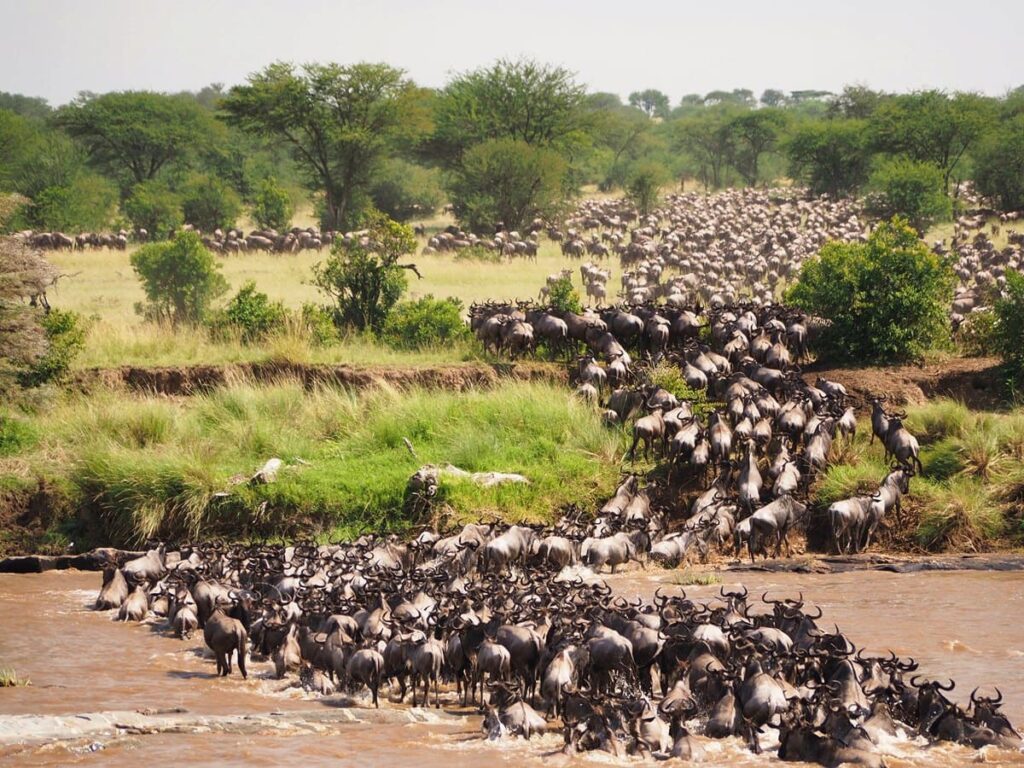
Every year, more than a million wildebeest, along with hundreds of thousands of zebras and gazelles, make a remarkable journey across the Serengeti-Mara ecosystem in search of fresh grazing, water, and the rains.
If there is one wildlife experience that captures the sheer drama of Kenya’s safari landscape, it is the Great Wildebeest Migration.
Picture thousands upon thousands of wildebeest stretching across the savannah as far as the eye can see. Then imagine them suddenly moving as one enormous herd, crossing rivers, navigating open plains, and trying to stay ahead of hungry predators.
It is wild, unpredictable, and completely spectacular.
More than the famous Mara River crossing, the Great Migration is a continuous cycle of movement between Tanzania’s Serengeti and Kenya’s Maasai Mara, driven largely by rainfall and the search for fresh grass and water.
So, what exactly is the Great Wildebeest Migration, why do the animals migrate, and when can you see it in Kenya?
Here’s a closer look.
What Is the Great Wildebeest Migration?
The Great Wildebeest Migration is the annual movement of more than a million wildebeest, accompanied by hundreds of thousands of zebras and gazelles, across the wider Serengeti-Mara ecosystem of Tanzania and Kenya.
The migratory wildebeest population is estimated at around 1.3 million animals, although the exact numbers can vary. The animals travel through a vast cross-border ecosystem rather than following a simple route from one destination to another.
One of the most fascinating things about the migration is that it isn’t a one-way trip.
The herds are constantly moving through the ecosystem in a roughly circular cycle, following rainfall, fresh vegetation and water.
Why Do the Wildebeest Migrate?
The short answer?
Food and water.
The longer answer is a little more fascinating.
The movement of the herds is closely connected to seasonal rainfall and the growth of fresh grass. As conditions change across the Serengeti-Mara ecosystem, the wildebeest move towards areas where food and water are available.
This means there is no exact date when the migration starts or ends; nature doesn’t work quite that neatly. The migration changes from year to year depending on weather and environmental conditions.
More Than the Wildebeest
Despite its name, the Great Wildebeest Migration is not a wildebeest-only affair. Zebras and gazelles travel alongside the wildebeest, forming one of the largest concentrations of migrating herbivores on Earth.
And where there are huge numbers of herbivores…
There are predators.
Lions, cheetahs, leopards, spotted hyenas and crocodiles all form part of this dramatic ecosystem.
The migration therefore creates a moving feast for the predators that depend on these herds for survival.
The Famous Mara River Crossing
If you’ve ever seen photographs or documentaries of the Great Migration, chances are you’ve seen the Mara River crossing.
This is arguably the most famous — and most dramatic — part of the migration in Kenya.
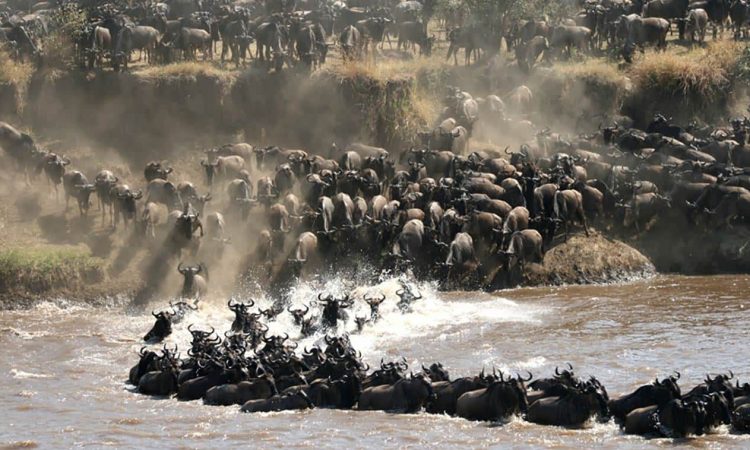
As the herds reach the Mara River, thousands of wildebeest may gather along its banks. They can hesitate for hours before one animal finally takes the plunge.
And then, suddenly, the waiting is over.
Wildebeest surge into the water, scrambling down steep banks and pushing through the current as they attempt to reach the other side.
Crossing the Mara River is dangerous. The animals face strong currents, steep riverbanks, exhaustion and the ever-present threat of Nile crocodiles.
Mass drownings can also occur during particularly difficult crossings. The Mara River is a dramatic backdrop for safari photographs as well as a genuine obstacle in the animals’ journey.
Perhaps that is what makes watching a crossing so extraordinary. However, there is no guarantee that it will happen while you’re there, since the migration follows nature’s timetable, and not ours.
When Is the Wildebeest Migration in Kenya?
The migration is often associated with July to October in Kenya, when the herds move into the Maasai Mara region and can be seen crossing the Mara River and spreading across the plains.
However, the exact timing depends on rainfall, grazing conditions and the movement of the herds. In some years, the animals may arrive earlier or later than expected.
For travellers hoping to see the migration in Kenya, July to October is generally considered the main migration season, with the Mara River crossings being one of the major attractions.
What Happens When the Wildebeest Aren’t in Kenya?
When the herds leave the Maasai Mara, the migration continues across the wider Serengeti-Mara ecosystem throughout the year.
During the wetter months, large numbers of wildebeest move through the southern Serengeti, where the availability of fresh grass creates favourable conditions for calving.
As the seasons change and grazing conditions shift, the herds gradually move northwards and eventually reach the Maasai Mara.
Then the cycle begins again.
The Great Wildebeest Migration: One of Kenya’s Greatest Wildlife Experiences
The Great Wildebeest Migration has become one of Kenya’s most iconic wildlife experiences, attracting visitors from around the world to the Maasai Mara each year.
It is easy to understand why.
There is something almost surreal about watching thousands of animals move across the same landscape together — especially when you realise that this journey is part of a natural cycle that has continued for generations.
And while the Mara River crossing may be the moment that makes the headlines, the real wonder is the migration itself: the movement, the survival, the predators, the landscapes, and the endless search for water and fresh grass.
That is the Great Wildebeest Migration.
It is one of those pieces of Kenya that is almost impossible to fully appreciate until you see it for yourself.
- September 3, 2026
- The Culture Archivist
Love Kenya's Wildlife?
Bring it to life. Create your own colourful safari with Colour My Kenya.